
MADONNA
a study on religion in art
DRUIDRY
Hither all, who have disputes, assemble from every part, and submit to their decrees and determinations. This institution is supposed to have been devised in Britain, and to have been brought over from it into Gaul; and now those who desire to gain a more accurate knowledge of that system generally proceed thither for the purpose of studying it. - Commentaries on the Gallic War, Gaius Julius Caesar, 60-50 B.C.E.
I'd like to preface this page by explaining the difficulties I had while trying to research early Celtic art, which was the original subject for this section of the project. There are a number of reasons for my switch to Druidry and Druidic symbols. First of all, the ancient Druids (and Celts in general) had a culture which existed and continued almost entirely through the sharing of beliefs, proverbs, poems, songs and the like through vocal means. Among the Druids, writing was considered a sign of laziness - in fact, it was considered unlawful to put Druidic verses in writing. "That practice they seem to me to have adopted for two reasons; because they neither desire their doctrines to be divulged among the mass of the people, nor those who learn, to devote themselves the less to the efforts of memory, relying on writing; since it generally occurs to most men, that, in their dependence on writing, they relax their diligence in learning thoroughly, and their employment of the memory," wrote Caesar in Commentarii de bello Gallico (Commentaries on the Gallic War) - the same passage quoted above this paragraph. I respect this, but given that Druidry was wiped out for over one and a half thousand years, it means that my resources for researching them and their culture are limited at best. That's the other issue; between the first or second century C.E. and the eighteenth or nineteenth century when Revivalists began to practice Druidry again, Druids simply didn't exist. There was nobody to share their messages, nobody to carry their story through time. Because of this, my only avenues of research are Caesar's two paragraphs on Druids, and resources on modern Druidry where I can find more detailed descriptions of their teachings. The most frustrating thing is the fact that I live in Britain in an area which is known for found artefacts spanning the Neolithic and Celtic eras, and I know of a particular archive which has plenty of weaponry, tools, accessories and perhaps even clothing from the Celtic culture, but because of the virus I can't even access the resources which would prove so vital to my research. I'm limited to the Internet, where I can't find a single article which gives sufficient information on Celtic life. I know the general climate of the time, I know how they cooked and created, but I have absolutely no clue what their life was like because of how rarely they wrote things down. What little information I have found mostly covers Celtic life after the Romans invaded and "civilised" Britain, meaning Celtic culture had already been heavily influenced by Roman laws and traditions. Unfortunately, while no culture was better or worse than the other, the Romans documented everything, so their lives can be analysed and scrutinised to my heart's content while the Celts' culture died when they did, no longer having mouths to pass it on. Okay, that's my rant over. Now let's try and immerse ourselves in the foundations of modern Western European culture!
Druidry is known to have been around in the fourth century B.C.E. due to a couple of references to them in Greek literature - one from Sotion of Alexandria and the other, much more interesting, a study on magic which is sometimes attributed to Aristotle, though this is often disputed. I would have loved to read this, but it has conveniently been completely lost and only exists in references from other scholars both of the time and more modern. There was apparently ten volumes of this, but I suppose there weren't enough copies made for them to have lived on - if there were copies at all. This is why you back up your files. The earliest detailed report on Druidry is the passage I've quoted twice already; just two paragraphs from Caesar's writings on the Gallic war. It was actually written, unsurprisingly, about Druidry in Gaul (France), but it does

acknowledge that they originated from Britain. While it is likely the most accurate and full report I'll be able to find on ancient Druidry, it's almost definitely skewed heavily against them and their culture. As the saying goes, history is written by the victors, and once Romans had conquered Europe, Druidry was lost to time and propaganda.
My own research did not start with the Romans. I started by looking into early Celtic art, specifically that from 800B.C.E. (around the end of the bronze age) to 400B.C.E. (Greco-Roman influences started to take a huge effect on Britain at this point). I wanted a "pure" place to start - the beginnings of artistic exploration and religion in my home country. I expected to find a lot more, but pretty much the only stand-out piece I could find was the Staffordshire Moorlands Pan (which is in the British Museum, my favourite museum! So frustrating that I couldn't visit). Thankfully, this pan contains one of the most important symbols in Druidry. Symbols, as it turns out, are one of the most important remaining elements from ancient Druidry. My friend (who is interested in Druidry herself, and has been an absolute gem during my research - you know who you are, and thank you so much for your help!) pointed me to this article which serves as a great starting point for my study on the Druids. I'll go through the symbols which I personally used/took interest in (some are far too modern for my research, one even thought to be from the 1600s), then we can further investigate prehistoric art as a phenomenon in the UK (and perhaps even visit some of the sites ourselves).
Symbols
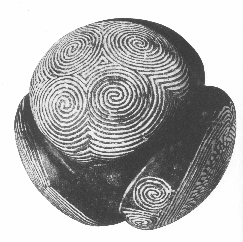
There are a number of motifs in Druidic culture. The first mentioned in the article, and perhaps the most recognisable symbol of Druidry, is the Triskelion - the triple spiral. Triads are a whole different subject, so I won't talk about that aspect of the Triskelion yet, but I'd like to point you back to the Staffordshire Moorlands Pan to consider this. It's covered in triple spirals. The Triskelion was an older, prehistoric version of the Greek Triskeles, that being a triad of human legs rather than interlocking spirals. The most significant (and only decidedly neolithic) example of an ancient Triskelion is that which is carved into the stones in Newgrange, Ireland. Interestingly, this particular spiral apparently predates Celtic influence on Ireland - this isn't particularly hard to believe as triads hold importance in many cultures, but it would be particularly intriguing if this turned out to be the very origin of the Triskelion - perhaps adopted by the nomads when they reached Ireland and taken back through their culture throughout the world. I'm just theorising, though - such things predate written records, so we have no way of knowing how they originated or spread. Here are a few examples of triple spirals, though I really couldn't find many which aren't simply jewellery or trinkets.


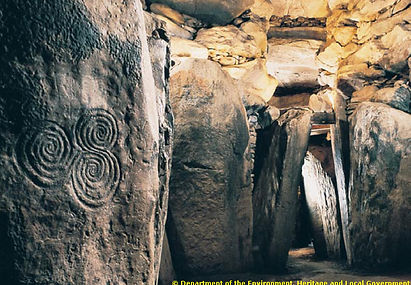
Strange as it may seem, all three of these photographs are from Newgrange. I honestly couldn't find one other example of prehistoric triple spirals - at least, not one which is known as a Triskelion. Perhaps you happen to know of one by chance - if so, please point me to it! It's incredibly surprising to me that such an important and versatile symbol seems to have so few examples from the ancient world.
Single spirals are another, perhaps more general, symbol. As stated in the article, the Celtic understanding of this enigmatic symbol is that it represents a journey, whether that be spiritual or physical. It can be found in so many cultures, though, that it's not as distinct as the Triskelion. I've tried to limit the photos on this one to pieces from Europe, as these pieces are more likely to originate with early Celts.



Similar to the single spiral (or Archimedean spiral) is the cup ring, or labyrinth. These are found mainly in rock art, which can be found all over Britain (aside from near where I live, apparently. Thanks, ancient artists). This is likewise thought to represent a journey, more specifically a journey to the afterlife. As such, these are often found at gravesites.


That's pretty much it for the symbols I used for inspiration, there are a couple more specific ones which I used in the art piece I made for this section, but I'll talk about them when I get into what the piece actually is. Before I start on that, though, I'd like to talk a little bit about triads in Druidry.
Three is an important, sometimes sacred, number in many cultures, and Druidry is no exception. According to A Treasury of Druidic Triads, their connections to the number went beyond worship and even affected their judicial system and way of life. Many Celtic proverbs and illustrations are based around triads - just some examples from the linked lesson being "Three signs of cruelty: to needlessly frighten an animal, to needlessly tear plants and trees, to needlessly ask for favours", "Three things to be avoided by the Wise: expecting the impossible, grieving over the irretrievable, fearing the inevitable" and "Three conditions for which one may be un-seated: for performing murder or warfare, for telling a falsehood, for divulging a secret which he or she holds". These are taken from the Irish triads of wisdom. The Welsh triads are more akin to Aesop's fables rather than short, general lessons. Another way in which triads play into this culture is the very first symbol I mentioned, the Triskelion. This triad is thought to symbolise the earth, sea and sky - the three "realms" followed by Druids to this day. Interestingly, this ties into the one written language used by the Druids - Ogham tree script. Druids believed that trees were incredible sources of power and wisdom (especially oaks, in fact, the original Celtic word for Druid - "Druwid" - means "oak-knower") and this was at least partially because trees are a point at which the three realms meet. According to my Druid-aligned friend, trees are seen as a bridge between the three. It comes as no surprise, then, that one particular future-telling ritual performed by ancient Druids involved writing or carving glyphs from Ogham script into pieces of wood and casting them across the floor. Ogham was also used, apparently, for short messages. Now we've considered the abstract symbols and some teachings of Druidry, let's talk about a more specific inspiration for the piece I made.
The Piece
Near the beginning of the project, I asked my friend if she could write a statement about her experience with Druidry to help me out with my research. I was finding it impossible to find reliable and concise information on it, so I wanted to hear from someone who had better resources and much more experience than I. Here's what she said:
When I first saw this Kalon, similarly to Nano, I got the sense of an ethereal nature, a god or goddess of sorts. However, unlike Nano, my mind drifted in a different direction. Our beliefs are different, as I study Druidry. Therefore, when looking at this Kalon, instead of relating them to a godlike figure you have heard of before, I was considering many different deities. Druidry is a modern spirituality which is inspired by the Ancient Druids and the Celts. In the Celtic pantheon, local deities are interrelated aspects or facets of the deities of the land, and Earth ("the Mother Goddess"). Whereas Nano saw the thorn-crowned Jesus in those curled horns, I thought of one Goddess that stood out to me; Arianrhod. She is considered a Goddess of beauty, fertility, reincarnation, the sky, weaving, enchantment. She is the Keeper of the circling "silver wheel" of stars, known as the Caer Arianrhod.
The ability to journey to parallel worlds is always available to Druids when we know the stars as celestial travellers. Often Druids are depicted as elder folk clad in robes, watching the night sky from lonely towers or ancient stone circles. This is because Druids gaze into this "silver wheel" or the cauldron of the Moon Lady (Arianrhod). Druids know the star pattern as the container of all that has happened and all that will ever occur. It is the resting place between lives and the source of Annwn (the Otherworld). Gazing and watching the moon and stars, Druids know our limitations and possibilities. This is why I felt a connection between this Kalon and Arianrhod, the design of this Kalon is fitting for the themes/aesthetic of the Goddess Arianrhod due to the colours being similar to that of moon and starlight, and the glow and shine of the Kalon also being akin to the Moon Lady.
As I believe I've stated before, I have no prior experience with Druidry. I had never heard of Arianrhod. However, having looked her up, my friend was absolutely right. Between Arianrhod's ethereal, otherworldly appearance and the undeniable similarity in colour palettes, not to mention the "halo" I had previously described seeming more akin to the Moon Lady's silver wheel, Madonna bears a striking resemblance to this moon goddess. It was based on this inspiration that I began to conceptualise my piece.
The purpose of my research was to find a recognisable artistic style which could represent Celtic art as a whole. What I found, however, that the Celtic artists simply didn't have a style which could be related to this project. They used abstract, simple symbols - too abstract to really create a reliable tie to Madonna. I had to come up with another way to tie this piece into Druidry.
Considering the fact that my specialism is in humans, I thought I may be able to depict a woman dressed in Celtic clothing, weaving at a Celtic loom (one of the motifs associated with Arianrhod) and bearing the colours of Madonna. So that's what I did, and here it is.

It's hard to put into words my many thoughts on the many different stages of this image, so I'll instead write chronologically along the creation of it. I have quite a few screenshots (unfortunately I didn't record a speedpaint, which was an oversight), so I should be able to explain each part of my process to a satisfactory degree. Let's begin.

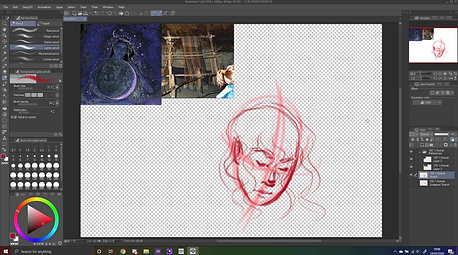

The initial sketch was an absolute pain. You can see my original reference in the top left corner of the second screenshot - my favourite representation of Arianrhod out of all of the images I saw, with her holding the moon and sitting under a veil of stars. I thought the veil of stars was a fantastic idea, but I wanted my own spin on it. I hadn't seen a single image of Arianrhod at a loom, and since it is apparently one of her most important symbols, I wanted to use it in my piece. That's the other image in my references; a Celtic weaving loom. As she would be weaving, I wanted her to be looking down. This was the hardest part. No matter how many references I used (I was flicking back and forth between my drawing tool and about a million websites during my sketching process), I just couldn't get the angle or pose to work. I tried both digitally and traditionally, and in the end, the sketch in the second image was the best I could come up with. I made a copy of it just in case I messed the rest of the sketch up and moved onto the body.

You may notice that the perspective on the loom in this sketch is all kinda of messed up. I didn't notice this until when I was lining it, meaning I had to move the furthest leg up and down until it looked right. You can see the beginnings of the veil here - at this point, I thought I would be drawing the full veil rather than having her head disappear into the sky, so the whole head is drawn out rather than just the front of the veil.


This is the final version of the lines - I altered the waistline and added a shawl (based on my investigations into Celtic dress) with a brooch containing a Triskelion. I used a pencil brush to do the lines - previously, I would fully line every single contour, leaving no gaps, and use the fill tool to put the base colours in. Gross, right? Now I do two sets of lines - one which is the actual linework and the next which covers the silhouette, made on a layer underneath the actual lines. This becomes the colour layer as I select everything outside the "lines", invert the selection and simply use the g-pen to fill the layer. You can see this in the second screenshot. The loom was a bit tedious during this process thanks to how skinny and wobbly it is, but it wasn't too bad. After I'd done the background, I filled the colour layer with a colour from Madonna's palette as a baseline for rendering.


It's been a long, long time since I've used a space-themed background in my work, but for the weaver of stars, it was necessary. After making a baseline with some different hues and the airbrush, I decided that I needed something more dramatic. It was just too monotone. While I appreciate peaceful scenes, I'm a sucker for drama, and both Arianrhod and Madonna seem like very dramatic figures. This is why I added a nebula to the background.
I've never actually drawn a nebula before, but it's not hard to find references for them and because of how chaotic they are, there doesn't seem to be many hard and fast rules for what they should look like. For mine, I used a few different layers including a cyan-into-green glow from behind the "cloud", the cloud itself which was a slightly dull orange and a few overlay/multiply layers to get the effect I wanted with the shading and backlight. I don't think it's too bad, for my first try. The shading on the cloud is quite intense, and it was pretty tough to get it to look right with such a vague and peculiar light source, but I think it's recognisably a nebula and I suppose that's all I can ask of myself with so little experience.


I noted once I began rendering Arianrhod/Madonna's face that she looked decidedly Catholic. I believe this was because the palette for Madonna is almost entirely grey, and the painterly shading reminded me of some statues of the Virgin Mary that I had seen. I decided to simply work on it for a while and try to make her look more Celtic, which I hoped would come along with further rendering. This ended up working out, surprisingly, as I darkened her skin tone to make her look less like a stone figure and added some colour using the single hue in the palette. It's worth noting that even the background colour was an altered form of one of the darker palette colours.
The arms were next up after I'd painted the veil to try to make it look semi-transparent. I had decided that the nebula would be the main light source (this is why I darkened the face so much, as she is facing away from the nebula) and followed this with the arm shading. the fingers were finnicky, as usual, but I think I managed to make them look fairly decent.

The clothes were next on my agenda, shading first the dress before laying the shawl on top of it. I didn't really want the dress to stand out too much so it's very simple, while the shawl is a lot more detailed and is made to look like the real thick shawls worn by ancient Celts. I also put in the colour for the rest of the shawl in, which had been done in the last image but I didn't have space to mention it.
Unfortunately, those are the only screenshots I have. I finished up the piece in the wee hours of the morning so I wasn't really thinking of documentation, I was just streaming on Discord to my friends. To be fair, there's not much left to cover, so I'll just do this in text form.
After I'd finished with the clothing, I put the loom colour on a new layer because it was going to be so different to the rest of the image. I used the palest colour on the palette as the base, used one of the greys with the pencil tool to make texture and finally shaded the whole image with the blue hue on the palette. I also added in the colour of the brooch, which I made with only colours from the palette again. One of my friends made fun of the fact that Arianrhod's head looked like it was cut off at the veil, so I added some texture there to make the intention clearer. Finally, I added a couple of multiply layers - one clipped to the colour and the other to the background - to put in some more depth and atmosphere.
Overall, I'm pretty happy with how this turned out. However, I do think that I'll need to stray from the palette in order to more accurately portray each artistic style. This will mean I need to use other ways to connect the art to Madonna, so I'll probably either use different aspects of her design in the art (such as roses, the halo and the tail symbol) or do secondary pieces which portray the Kalon form herself. I'm not particularly good at feral art, though, so we'll see how that goes.
After looking at the finished piece for a while, I decided to make an alternate version using a blurred background, so that it was less flat. It's a subtle change, but I think I like it.

This will probably be the most time and effort I put into any page on this website, mainly because of how hard it is to find information on the ancient Celts and Druids. I was planning to visit the Uffington White Horse and Avebury, but as of the date I'm writing this (May 23rd), the National Trust have put notices up on each page stating that their facilities are closed. Since they run the car parks and the two sites are two hours away from me, this means that I'm simply unable to access either site. It's a shame, as I've wanted to visit White Horse Hill for as long as I can remember, and Avebury has so many artefacts from the Neolithic era. I have a sneaking suspicion that they've put the notices up to deter any visitors from swarming the areas on Bank Holiday Monday, so I'll check back on Tuesday and update this page with whether or not I'll be able to go.
In conclusion, studying Druidry has really changed my perspective, not only on this Kalon but also on Paganism as a religion (and Druidry as an offshoot of that). It's a terrible tragedy that their culture has all but died out, but I will certainly continue to take an interest in the culture which formed my country from now on. Interestingly, as a descendant of a Scottish clan (though I was born in and continue to live in England), my ancestors in particular held onto Paganism and Celtic culture far longer than the English. But that's neither here nor there.
I'd say that the reason this page is so long is mostly because of the insane amount of research I had to do just to extract what little information I have. I've had far too many tabs open for over a week now, and haven't been able to shut off my laptop because of it. So much information was completely unfounded (for instance, the theory that Druids came from Atlantis, with no proof other than the construction of Stonehenge), so I tried to only include what was well-sourced or at least mentioned by multiple publications. While it's been tricky, I've deeply enjoyed this little adventure and what I've learned during it. Now, onto Catholicism.