
MADONNA
a study on religion in art
MAYA
I believe that Atlantis did exist. And when the Earth moved and the waters came rushing in upon it, a continent was submerged and a remnant survived. And from these evolved the great Mayan civilisation. - F. A. Mitchell-Hedges
Everyone's heard of the Mayan and Aztec empires. Their temples dominate the landscape of modern-day rural Mexico, standing tall as some of the only remnants of this ancient culture. The Aztec empire, having occurred after the fall of the Maya, is much better documented; it's near impossible to find anything of substance while researching the latter. The Aztecs also brought about some of the most famous art from their similar cultures. However, I've decided to talk about them both in this project as the Aztecs considered themselves to be successors to the Maya, plus the older civilisation exhibited the geometric style of stone carvings that we all know and love. (Also, the Aztecs created one of my all-time favourite pieces of art so I had to talk about them). This'll be a comparatively short page after the behemoth that was Catholicism (and possibly even shorter than the Hellenic page), but let me talk you through some of my research.
One of the first things I found out about the Maya is that, contrary to popular belief, they're still around today. While there was a mysterious collapse of the Mayan empire, this didn't actually result in the outright disappearance of the Maya themselves. Many of their city-states stuck around even after the fall of Tikal (one of the most powerful cities in the country), and there are even people still alive today, mostly descendants of the Maya, who practice their religion. Some Maya beliefs include:
-
13 layers of Heaven, each governed by a separate
god - highest of all being the muan bird -
9 layers of "Hell" or the Underworld
-
At least 166 gods
-
Kings of the Maya became gods after their death
-
The villages of the Maya were centre of the universe
Unlike the Druids, a lot of what we hear about Maya rituals are quite accurate. Ritual bloodletting, self-mutilation, animal sacrifices and even human sacrifice were common in their culture. The popular image of a Maya priest ripping someone's heart out is partially true - the work was done by individuals called nacoms rather than the priests themselves, but the rest of it is accurate. These practices were offerings to their gods. The Maya gods controlled effectively everything on Earth, so it was of paramount importance to please them. The gods sent rain, grew crops, embodied the sun and moon, aided them in hunts and much more. Perhaps this was one of the reasons their civilisation had such a quick collapse - it happened in a time of repeated decades-long droughts, so it's thought that the Maya people may have turned on their gods for not providing them with the things they needed to survive. With that, they would also rebel against those
who acted as vessels for the gods: kings and priests.
Regardless of what caused the decline of the Mayan empire, they left behind countless artefacts which tell us of their culture. Let's have a look at a few of these, as well as one or two Aztec items (because one of them is kind of important to me).
Architecture


This one's Aztec!

The temples of both Maya and the Aztec empire are some of the most iconic in the world. They use the classic pyramid shape, the structural stability of this technique having kept them around for centuries. They're the epitome of ritual art; enormous structures built to appease the deities they worshipped. They were hubs of religious activity, too, featuring steep staircases to the temple itself (atop the pyramid structure) which would be climbed each time a sacrifice was performed. Temples were always at the centre of each settlement, making them the centre of the centre of the universe in Maya beliefs. Perhaps one of the most famous pyramids is the Temple of the Feathered Serpent, often associated with the primarily Aztec god, Quetzalcoatl, although the temple itself was built around 200 C.E. - during the height of the Mayan empire and long before Aztecs would come about.
Sculpture


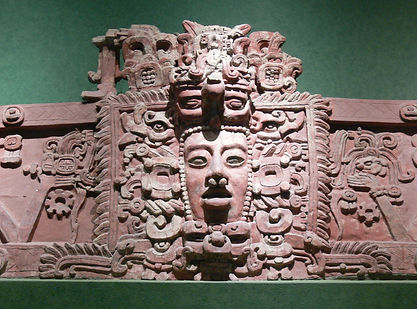
Maya sculpture, much like the architecture, was often made as an offering to their gods. You may notice that the lowest picture is somewhat unlike the others, made out of different materials with a more geometric, polished nature. This piece is by the Aztecs, and is one of the only historical, religious artefacts I had taken an interest in before this project. It's called the Double-Headed Serpent, it's in the British Museum and I'm lucky enough to have seen it twice. It's quite small in real life, in a small dark compartment behind a glass pane. I had seen it around in history lessons and the like before my first visit to the British Museum, but didn't realise it was there and it was quite the shock when I saw it. It's intricately detailed, brighter than you could believe and reading about the materials used to make it is fascinating! Its eyes, when they were still there, are thought to have been made of iron pyrite (fool's gold) - held in by beeswax, unlike the mosaic which is adhered onto the wooden body with resin. I just adore this piece from a visual standpoint, and it's really the main reason I wanted to mention the Aztecs in this page too.
Pots

I'm gonna be honest, I just thought this guy was neat. That's all for this section.
The Piece
Alright, here goes! Getting this piece to a state I was happy showing was quite the trip, so here goes. I'll be doing a picture timeline again as I don't have a speedpaint.


I had a few sketches for this piece, and these are the most developed, "final" versions of them. I wanted to imitate the very geometric and square-based style of Maya stone-carvings so, before starting the sketches themselves, I mapped out square grids based around the vague shape I wanted the figure to be. I then used these guides, keeping the body snapped to them as much as possible and allowing myself some liberty with details such as legs and facial features. I switched back and forth between drawing Quetzalcoatl and Madonna, with the rightmost image being a more "realistic" version as I was struggling with the lack of detail in carved images. I decided to use the stylised portrait of Madonna for my piece. You may notice that she has no wings or tail shine; I found that these elements simply didn't work with the style. The wings couldn't be placed right between the folds of the back, and nothing in Maya art is as complicated as the shine (yes, it took me this long to figure out that it's her shine). Don't worry, though! I should be able to implement it into the Norse piece. Anyway, let's have a look at what the
sketch looked like after I digitised it.

My poor eyes! Yeah, this is pretty atrocious. Easily the worst piece in this project, so I knew even before I'd finished it that I'd need something else to make up for this travesty. I figured that using such a limiting style just wouldn't work with my skill-set, so I decided to use the idea which I had intended to use for the Druid piece - a study of the culture's dress, with an adaptation of Madonna's design to suit the style of that era.
Turns out, there isn't much Maya clothing around. Most of what I found is also quite simple and unassuming, not like the warrior chieftain vibe I was going for. I found one historical reference of a king's clothing in the Mayan empire:

My main inspiration was the male clothing from the "ruler" image in this picture. I didn't want to copy it exactly so I added some things, took out some others, while keeping the same theme and trying to make the materials look like they'd come from a Maya outfit. Since the man is shirtless in this outfit, I added a strip of fabric to cover the figure's chest.


I picked her skin tones from the famous flesh cloud, using a range of colours for both shading and highlights with a similar method of colour to the one I used in the Druidic piece. I had some struggles with her arm, and ended up going over it to imply the presence of a bicep. I'm not particularly good at anatomy so it's not perfect, but it looks better than it did. I've never attempted to properly draw abs before so I'm pretty happy with how these ones turned out. I got into a groove while colouring her clothing so I don't really have any screenshots from that, but here's the finished portrait:

It's not perfect by any stretch of the imagination; the textures aren't great, the shadows are too soft etc... but I'm happy with it, especially when compared to the previous piece for this section. I felt bad for excluding my ugly child, though, and made
a "mashup" piece.

To conclude, while this certainly hasn't been the most in-depth I've gone with a culture, I really enjoyed working some elements of their mythology and style into a piece of art! Now for our final culture, which should tie us back to the Celts: Vikings.